
⚠️ Note to the reader: This article contains references to trauma and triggers. Treatment options mentioned may give varying results and not always be right for everyone. Please reach out to local healthcare providers if you’re worried about your health. This subject is also explored in more detail in my book Answers In The Dark: Grief, Sleep and How Dreams Can Help You Heal.
What are Nightmares?
Nightmares are essentially bad dreams and so are different for everyone: a nightmare to me, might not be for you. If you’re scared of dogs, a dream containing them can be terrifying, whereas to someone who loves those furry friends, it wouldn’t be a nightmare at all.
They can be loud, violent, or just unsettling. They’re not always gory, although those that are can be particularly distressing. They can take many shapes and forms, involving people, objects, scenarios and all kinds of symbolic references. They can relive past events which we feel like we can’t escape from, and they can be repetitive. Some people have nightmares frequently as a result of a life changing event, others may have them periodically.
What causes them?
Anniversaries, movies, even a familiar scent can be enough to remind us of what’s gone before. Music in particular is like time travel and there will be times when current day events may take us back to places in our minds that were painful. Even a particular news story may prompt a difficult dream that gets our attention.
Some research suggests that we produce less cortisol when we’re dreaming – even if we’re having a bad dream – so our nightmares provide an opportunity to help us work through what we’ve been through, without becoming as distressed as we would if we were reliving it during the day. People who have been subjected to traumatic events are likely to experience nightmares for this reason as their brain tries to work through what’s happened.
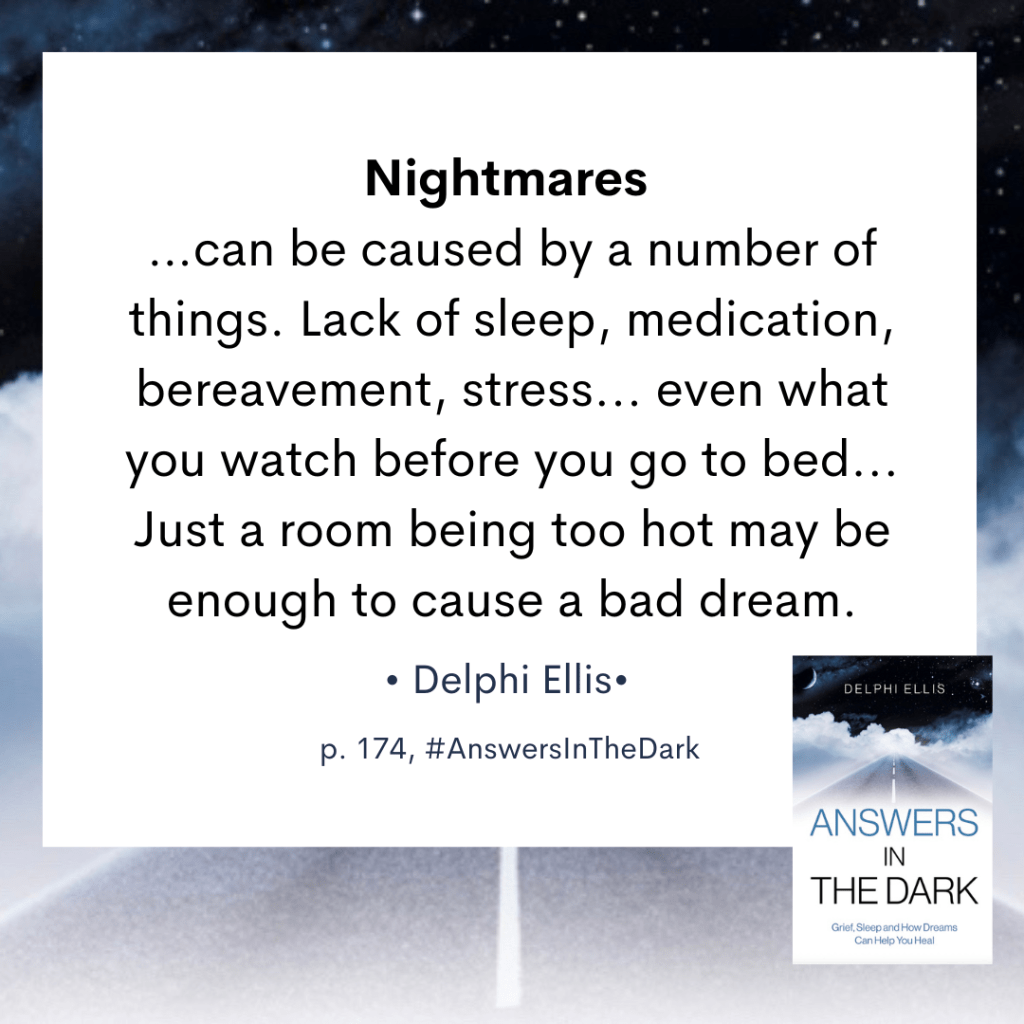
Ironically though, sleep deprivation may also cause bad dreams, which can create a vicious cycle – we can’t sleep, so we have nightmares when we do eventually doze off, which may then cause us to have problems sleeping. This also means that the process of recovering from trauma can take longer, if the nightmares themselves are what help us work through it, but are prevented due to lack of sleep.
Keeping a dream diary can be useful (as long as it doesn’t add to the distress), to help spot patterns in why nightmares appear when they do; if we know what prompts them, we can manage them more helpfully. (I offer tips on how to keep a dream diary, and a Sleep Cycle Repair Kit in my book Answers In The Dark).
Ironically, some forms of medication (even those designed to help us sleep better or manage our mood) may prompt nightmares, as can the reasons you’re taking them; always have a chat with your healthcare team, if you think it could be that.
Importantly, like our dreams, nightmares can be trying to tell us something. Sometimes what we’re not dealing with during the day, can show up in our sleep at night. It might be a relationship breakdown, the pressure of work, or something less obvious. Nightmares might be telling us we’re overwhelmed and need a break. They are not a sign we are flawed in some way; they are a normal response to the world we live in and the experiences we have.
What helps?
Where nightmares refer to or replay lived experiences as if they’re happening again, you might find forms of treatment like EMDR of some benefit.
Self-care is also essential, and taking a step back when we need to find our way back to centre. Also check coping strategies are healthy and if needed, ask for help (especially if those mechanisms are harming you or others in some way.) If you’re noticing elevated or intense emotions, like anger, check what those feelings are really trying to tell us. Anger, for example, is a secondary emotion that can be triggered by another like fear.
Over time, you might notice some nightmares become less intense and less troubling – this is why dreams have been described as overnight therapy to help us work through difficult times – especially if we find ways to explore them helpfully. You might find when you wake up you’re less affected than you used to be, knowing this is normal and that nightmares are just trying to help. As you take time to explore them safely (or their pattern), at a pace that’s right for you, you may be able to work out why and what, if anything, you need to do about it.
You may also find engaging in Grounding and/or Protection activities useful.
Most importantly though, please remember your brain is working helpfully to try and process what you’ve been through. Sometimes you might need help with that, and that’s a choice you can make if and when you’re ready. Ultimately though, be gentle with yourself do what’s healthy and right for you.
Delphi is the author of Answers In The Dark: Grief, Sleep and How Dreams Can Help You Heal, out now on Amazon and Hive. The Dreams Maven™ is part of the Helping You Sparkle™ portfolio. You might also like Monday Mojo™.
Out Now
The 4 am Mystery: That’s an actual thing by the way. Even before a global health crisis, people found themselves awake in the middle of the night. Answers In The Dark aims to join the dots between sleep, dreams and our mental health, specifically how grief shows up, even if no one has died.
It explores some of the Big Myths of sleep, offers a Sleep Cycle Repair Kit and tips on how to decode your own dreams. Out now on Amazon and Hive.
#1 Best Seller on Amazon for its category.
© Delphi Ellis 2023 – please note this content may also appear elsewhere as promotional material for Answers In The Dark.
 The Dreams Maven™
14 thoughts on “Having Nightmares? Here’s Why That Might Be Normal”
Comments are closed.